

April 15, 2026•10 min read
How Does the YouTube Shorts Algorithm Work in 2026?
Master the 2026 YouTube Shorts algorithm. Learn about the explore/exploit system, the March 2025 view update, and strategies to bypass the seed audience wall.

Crack the Algorithm's Semantic Code
Align your metadata pillars, capture the curiosity gap, and trigger exponential organic loops.
Every single minute, over 500 hours of video content are uploaded to YouTube. In this astronomical sea of data, the recommendation engine does not watch your video first—it reads it. The recommendation neural networks (specifically the Candidate Generation and Ranking towers) rely on metadata as a translation mechanism to map your content to the correct target audience.
Title CTR Formula
Formulate titles that leverage the Curiosity Gap to force user clicks and skyrocket CTR.
Description CRS Zone
Design descriptions that align with Contextual Relevance Scoring to dominate the sidebars.
Strategic Tags
Use tags as semantic safety nets to cluster your video with trending, high-traffic topics.
The Science of the Curiosity Gap and High-CTR Psychology
Your title is your first handshake with the viewer. While the algorithm uses it to determine initial search intent and categorization, its principal function is to capture attention. If your title is boring, your Click-Through Rate (CTR) will plummet, causing the algorithm to suppress your impressions, no matter how good the actual video content is.
The curiosity gap is the cognitive space between what a viewer currently knows and what they want to know. Viral titles don't explain the whole video—they raise a question that can only be answered by clicking.
"Your title should not summarize your video. It should promise an emotional payoff or a resolution to an intriguing conflict."
I [Action] for [Duration]... Here is what happened.Example: "I Built a House with Only $1,000 (30 Days)"
[Extreme Challenger] vs [Impossible Obstacle]Example: "$10 Car vs $1,000,000 Supercar"
Optimizing for Contextual Relevance Scoring (CRS)
While titles appeal to human psychology, descriptions feed the indexing algorithms. In 2026, YouTube uses Natural Language Processing (NLP) models to scan your description for Contextual Relevance Scoring. This score dictates where your video appears in the Suggested Video sidebar.
This section is visible before the 'Show More' fold. Write a natural, compelling summary of the video that directly incorporates your primary keyword. Avoid external links here, as they hurt search index formatting.
Write a highly structured breakdown of the video content. Treat it like a mini blog post. This is where you naturally layer secondary keywords and Latent Semantic Indexing (LSI) terms.
Add interactive timestamps (starting at `0:00`). YouTube translates these directly into Google Search "Key Moments" and interactive video chapters, which can double your secondary search impressions.
Always label your chapters with action-driven search intent. Instead of writing `1:32 - Section 2`, write `1:32 - How to set up camera angles`. This helps search crawlers map exact segments to long-tail user queries on Google.
Why Tags are Not Obsolete & How to Group Your Topics
If you upload a video with an abstract, highly psychological title like "It's Finally Over...", how does the algorithm know if it is about a political campaign, a tech product launch, or a gaming channel? It parses your tag neighborhood.
Tags in 2026 act as a Semantic Anchoring System. They do not rank your video directly, but they clarify contextual ambiguity, bridge misspelling clusters, and secure your place in the sidebar of related videos.
The exact target phrases from your title. If your title is "How to grow on YouTube with AI", your Tier 1 tags must contain `"grow on youtube with ai"`.
Phrases that narrow down your industry segment. E.g., `"youtube growth hacks"`, `"ai video tools"`, `"viral script generator"`.
High-level classification directories. E.g., `"content creation"`, `"social media marketing"`, `"creator economy"`.
Include common misspellings or variant pronunciations of your brand or topics in the tags. If your username is frequently mistyped, having those mistyped tags ensures you don't lose that search traffic.
Aligning Your Pillars to Avoid Algorithm Suppression
The YouTube algorithm compares your Title, Description, and Tags to calculate a **Relevance Coefficient**. When these three points align perfectly, your video's contextual certainty is high, making it easy for the neural network to recommend it.
However, if your metadata drifts—meaning your title is about *cooking tutorials*, your description is a link dump of *gaming gear*, and your tags are filled with *celebrity drama*—the algorithm gets confused. When the recommendation engine cannot calculate contextual certainty, it stops suggesting the video to avoid risking viewer drop-off.
Writing aligned metadata manually requires hours of cross-referencing trending terms and mapping LSI clusters. The Cre8Virals AI tool suite automates this entire mapping workflow:
Our engine uses real-time semantic graphs to generate high-CTR titles while simultaneously drafting descriptions that echo your target keywords organically.
Before you copy your metadata, our analyzer scores your Title-Description-Tag alignment, highlighting any "drift" that could trigger spam filters.
Stop guessing. Use the Cre8Virals metadata suite to construct curiosity-gap titles, SEO descriptions, and tags that guarantee organic reach.
No. If a video is underperforming, re-optimizing the metadata is one of the best ways to revive it. Changing titles and thumbnails to target a higher-CTR curiosity gap can trigger the algorithm's recommendation loop to re-test the video with a fresh seed audience.
YouTube's search indexing engine typically updates metadata indicators within 20 minutes to 2 hours. However, changes to recommendation feed behaviors (Suggested and Home feeds) depend on real-time viewer satisfaction signals (like CTR and AVD) and can take 24 to 72 hours to stabilize.
Tags are not useless; their role has shifted. Instead of ranking your video directly, tags act as semantic anchors. They prevent miscategorization by providing literal context to abstract titles and mapping common misspellings or related slang terms, which directly feeds into sidebar recommendation logic.
Absolutely not. This is known as 'Metadata Stuffing' and violates YouTube's Spam Policy. If the algorithm detects repetitive keyword blocks that don't read as natural human language, it will suppress your impressions and can even lead to community guideline strikes on your channel.
Keep your title between 50 to 60 characters. YouTube truncates titles at around 60–70 characters on mobile devices. Placing your highest-impact hooks or target keywords in the first 45 characters ensures they remain fully visible across all devices and won't get cut off by the ellipsis (...).
Master the 2026 YouTube Shorts algorithm. Learn about the explore/exploit system, the March 2025 view update, and strategies to bypass the seed audience wall.
Struggling with low click-through rates? Learn how the Cre8Virals AI Thumbnail Maker engineers high-CTR layouts using human eye-tracking vectors, MrBeast storyboards, and emotional color clash logic to multiply your organic views.
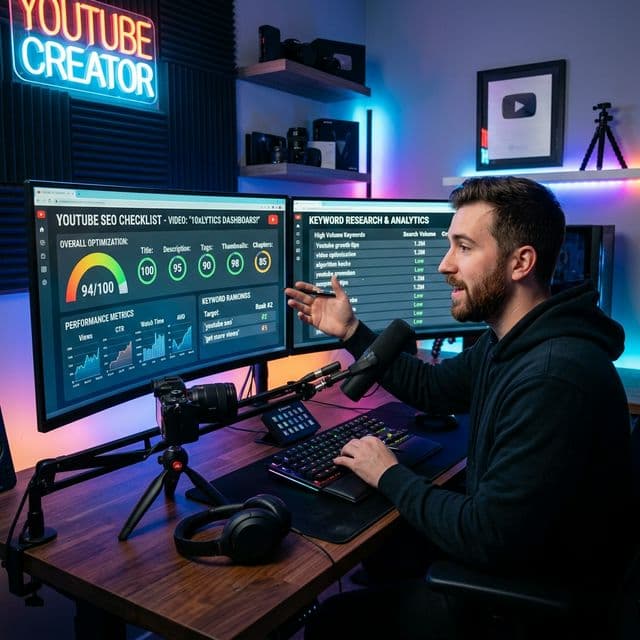
Discover how AI keyword generators for YouTube are transforming search engine optimization in 2026. Learn about semantic clustering, intent matching, and organic growth hacks to dominate search results.