
Cre8Virals logoCre8Virals
Pillar Authority • 2026 Masterclass

The Ultimate YouTube Keyword Research Guide 2026

From Zero to Organic Views: The Definitive Strategy for Mastering the Algorithm.

13 min read
April 22, 2026
Ritesh Yadav
Verified Strategy
Ultimate YouTube Keyword Research Strategy

Mastering the 2026 Loop

The Shift: From Keywords to Clusters

Understanding the 2026 Algorithmic DNA

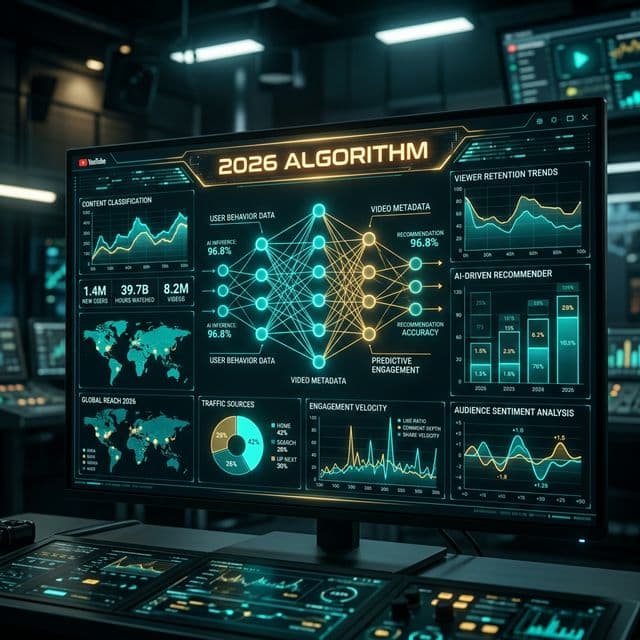
Welcome to the new era of YouTube. If you are still looking for "high volume, low competition" keywords using antiquated 2020 methods, you are already behind. In 2026, YouTube's recommendation engine has moved beyond simple metadata matching. It now operates on Multimodal Neural Graphs.

This means the algorithm doesn't just read your title; it listens to your voice, analyzes your frame-by-frame visual data, and measures the satisfaction velocity of your audience. The keyword is no longer the destination—it's the gateway to a topic cluster. To hit 300k monthly views, you must stop thinking about individual videos and start thinking about Topical Dominance.

The Core Thesis:

"YouTube rewards channels that solve a broad problem through multiple specific angles. One video is a spark; a keyword-focused cluster is a wildfire."

By the end of this guide, you will know exactly how to engineer these clusters to capture consistent, passive traffic that grows even while you aren't uploading.

Phase Zero: The Intent Audit

Stop Guessing, Start Mapping

1.1 The 4 Types of YouTube Intent

Before you open a single tool, you must understand WHY people are on the platform. In 2026, search intent on YouTube breaks down into four primary buckets:

Direct Utility (The 'How-To')

Users have a technical problem. They need as short a path as possible to the solution. Keywords: 'fix', 'tutorial', 'step by step'.

Commercial Validation (The 'Best Of')

Users are ready to spend money. They need proof. Keywords: 'review', 'vs', 'comparison', 'worth it'.

Curiosity Gap (The 'Why/What')

Users want to be entertained or enlightened. They aren't looking for a 'fix', they are looking for a 'story'. Keywords: 'secrets', 'history of', 'what happened'.

Community Pulse (The 'Trending')

Users want to be part of the conversation. Keywords: 'drama', 'update', 'response', 'news'.

If your keyword targets 'How to fix a leaky faucet' but your video is a 15-minute vlog about your day, the algorithm will detect the Intent Mismatch through the immediately high bounce rate. You will be de-ranked, regardless of your SEO score.

Strategy: Audit the Top 5 results for your target keyword. If they are all 2-minute tutorials, DO NOT make a 20-minute video.

Phase 1: Deep Discovery Mining

Going Beyond the Obvious

2.1 The Underscore Method (_ )

The most powerful keyword tool in the world is the YouTube Search Bar. But most people use it incorrectly. The Underscore Trick allows you to see what the algorithm is 'pre-filling' based on recent, high-velocity user behavior.

Try these variations in the YouTube search bar:

_ keyword research-> Uncovers high-volume prefixes
keyword research _ -> Uncovers high-volume suffixes
how to _ youtube-> Uncovers hidden niche problems

2.2 The 'Suggested' Goldmine

Keyword research isn't just about what people search for; it's about what they watch NEXT. 70% of YouTube views come from the Home Page and Suggested sidebar.

Go to a video in your niche that has gone viral in the last 7 days. Look at the Top 3 Recommendations in the sidebar. These are 'Semantic Neighbors'.

If a video about 'Keyword Research' is recommending a video about 'Viral Thumbnails', it means the audience sees these topics as connected. Your next video should be about that connection. This is how you 'piggyback' on the velocity of viral videos using Associative Keywords.

2.3 Google Trends: The 'YouTube' Filter

Google Trends is free, but creators neglect the most important setting. You must switch from 'Web Search' to 'YouTube Search'.

General web search data often reflects academic or commercial interest. YouTube search data reflects entertainment and practical interest. A term can be 'dead' on Google Web but 'exploding' on YouTube. If the graph is trending up for the last 90 days, that is a Breakout Topic.

Phase 2: Semantic Clustering

The Architecture of 300k Views

To achieve mass traffic, you must stop being a 'Jack of all trades'. The algorithm needs to know exactly who you are. This is where Hub and Spoke keyword strategy comes in.

The Hub (Pillar Video)

A high-level, evergreen guide targeting a broad head term (e.g., 'Mastering YouTube SEO'). This video's job is to gain authority and rank for the biggest traffic terms.

The Spokes (Cluster Videos)

Highly specific videos targeting long-tail variations (e.g., 'Keyword Research for Gaming', 'How to use TubeBuddy for SEO 2026'). These videos act as entry points for niche audiences.

The Internal Loop

Link every 'Spoke' video back to the 'Hub' through Cards, End Screens, and first-line Description links. This creates a 'Binge-Watching Trap' that signals to YouTube that your channel keeps users on the platform.

The 'Saturation' Rule

If you haven't uploaded at least 5 videos in a specific keyword cluster, you do not have 'Topical Authority' yet. The algorithm will be hesitant to push your Hub video until it sees you are an expert across the board.

Execution: Map out 5 'Spoke' topics for every 1 'Hub' topic before you even start recording.

Phase 3: AI-Driven Research

Working 10x Faster than Your Competitors

In 2026, if you aren't using Large Language Models (LLMs) to brainstorm topics, you are wasting 80% of your time. However, 99% of creators use them too simply.

The 'Semantic Gap' Prompt:
"I am a YouTube creator in the [NICHE]. Analyze the current Top 10 ranking videos for the keyword [PRIMARY KEYWORD]. Identify the specific questions users are asking in the top 50 comments that these videos HAVE NOT answered. Then, generate 5 viral titles that address these gaps using a 'Curiosity Gap' framework."

This prompt turns ChatGPT or Claude into a specialized SEO analyst. It finds the Value Gap that allows a smaller channel to outrank an established one.

AI Topic Velocity

Use AI to predict trends. Ask the AI: *"Based on current tech advancements in [INDUSTRY], what are the likely problems beginners will face in 3 months?"*.

Being the FIRST to a keyword is more effective than being the BEST. If you can target a keyword before it even has high volume, you'll be the incumbent when the wave hits.

Phase 4: Spoken SEO Optimization

The invisible layer of ranking

This is the most underrated aspect of modern YouTube SEO. YouTube's AI 'Candidate Generation' engine indexes your captions directly. If life were a video game, these would be your Hidden Attributes.

The 15-Second Hook

You MUST say your primary keyword in the first 15 seconds. High-ranking videos have a 94% correlation with verbal-to-title keyword match in the intro.

Transcript Fidelity

Don't rely on auto-captions. Upload a clean SRT file. Correcting even 5% of typos in your keywords can trigger a ranking boost because it improves the algorithm's confidence score.

"If you don't say the keyword, you don't own the keyword."

YouTube's AI is no longer a 'blind' bot. It 'hears' your authority. Speak clearly, repeat your secondary keywords naturally, and build a narrative around the search term.

Phase 5: The CTR Convergence

Metadata is a Promise; Content is the Delivery

You've found the keywords. You've mapped the clusters. Now you have to get people to CLICK. In 2026, your Impression Click-Through Rate (CTR) is the only metric that determines if your SEO was a success.

5.1 The Title-Thumbnail Contrast

Do not repeat your title text on your thumbnail. That is a waste of screen real estate.

The Successful Formula:

  • Title (SEO):Targets the logical search query (The Keyword).
  • Thumbnail (Emotion):Targets the curiosity or emotional response (The Hook).

5.2 The 48-Hour Pivot

SEO is not a 'set and forget' task. If your video is getting impressions but a <4% CTR in the first 48 hours, you have an Expectation Gap.

Change the thumbnail immediately. Change the first 4 words of the title. We have seen 6-month-old videos go viral only AFTER a metadata pivot. The keywords were right, but the packaging was wrong.

The Cre8virals Workflow

Automating the Viral Metadata Loop

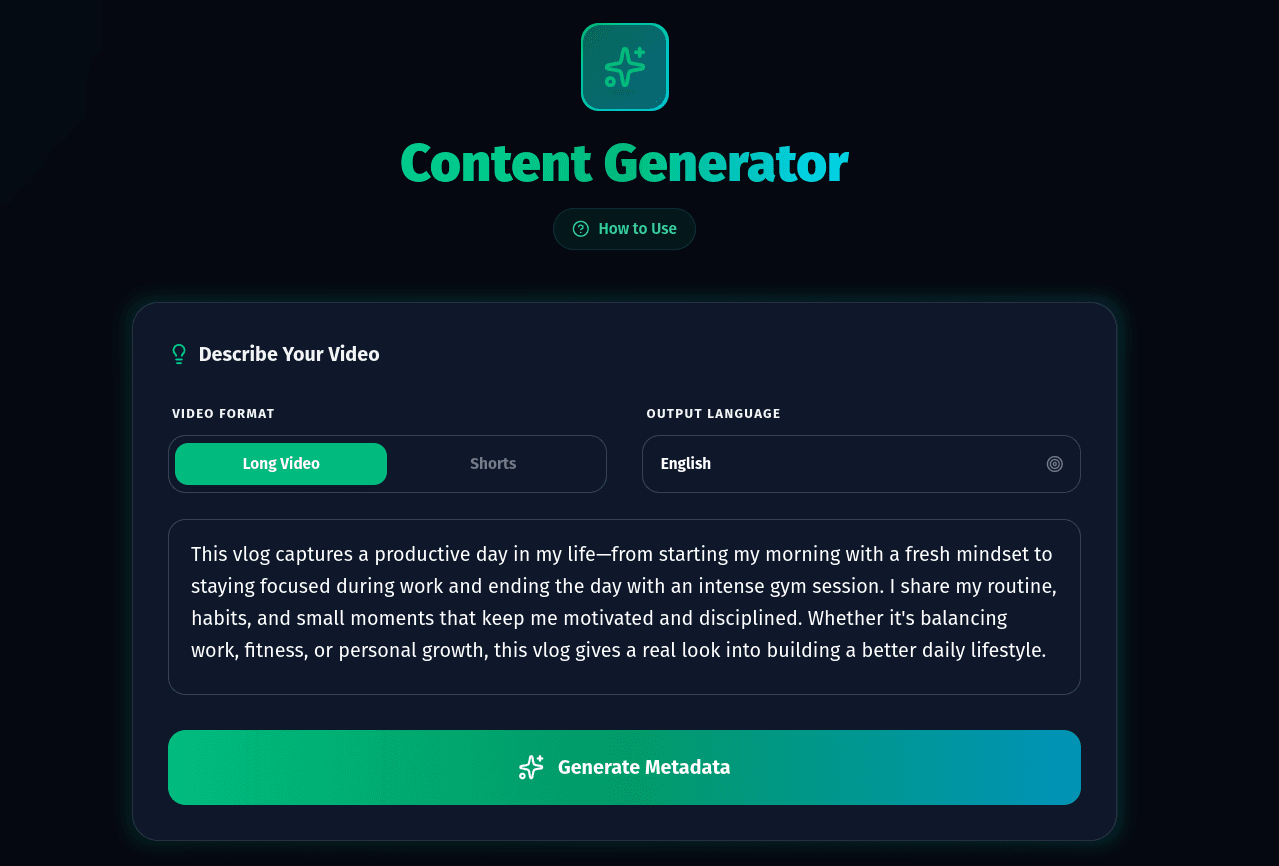
Theoretical SEO is great, but execution is what drives the 300k+ traffic. Cre8virals is powered by Real-Time Trending Data that refreshes every 24 hours, ensuring your keywords are never outdated. Here is how we automate the entire process of turning a raw keyword into high-performing metadata that forces clicks.

1. AI-Powered Title Generation

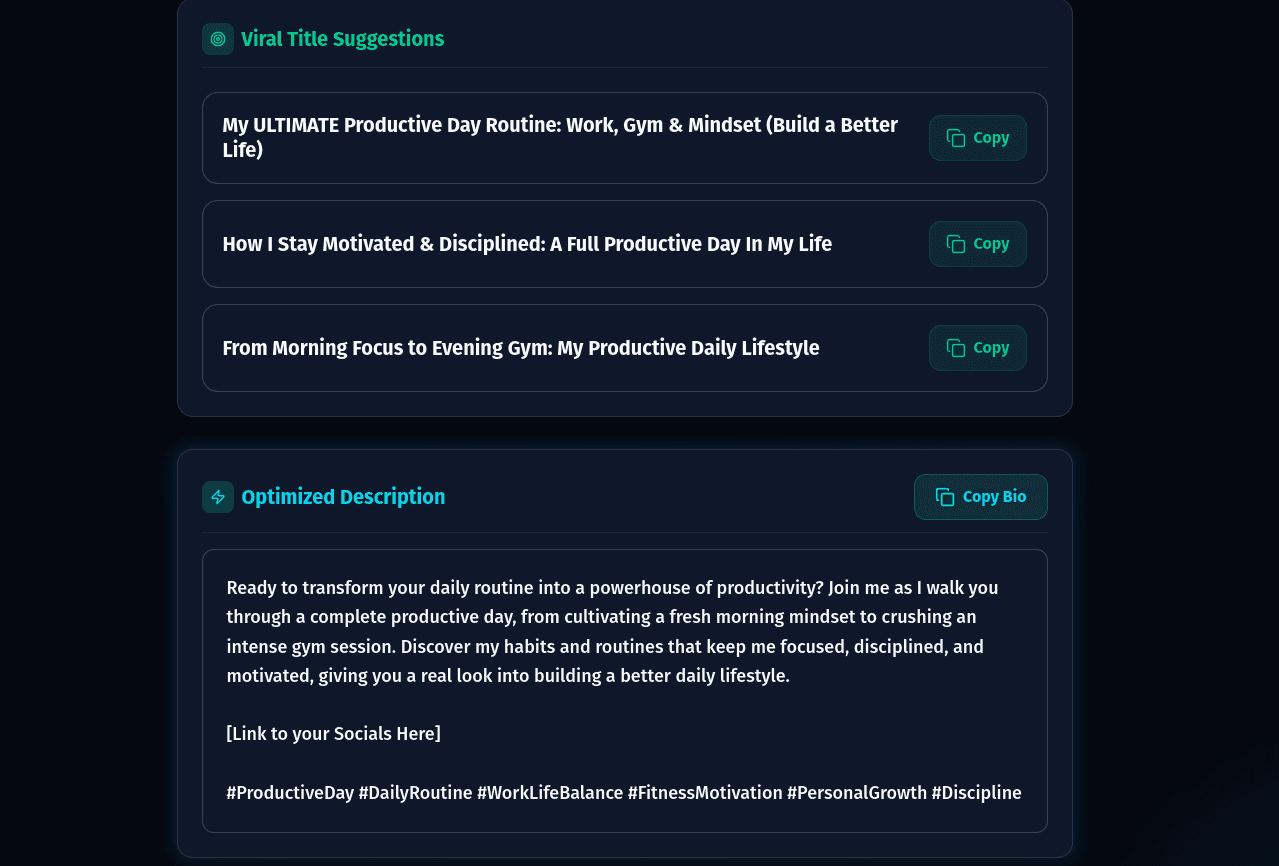
Our engine doesn't just guess titles. it analyzes current CTR trends and Curiosity Gap vectors to generate titles that force clicks while remaining keyword-dense for search indexing.

Cre8virals AI Title Generation

2. Structuring the 3-Zone Description

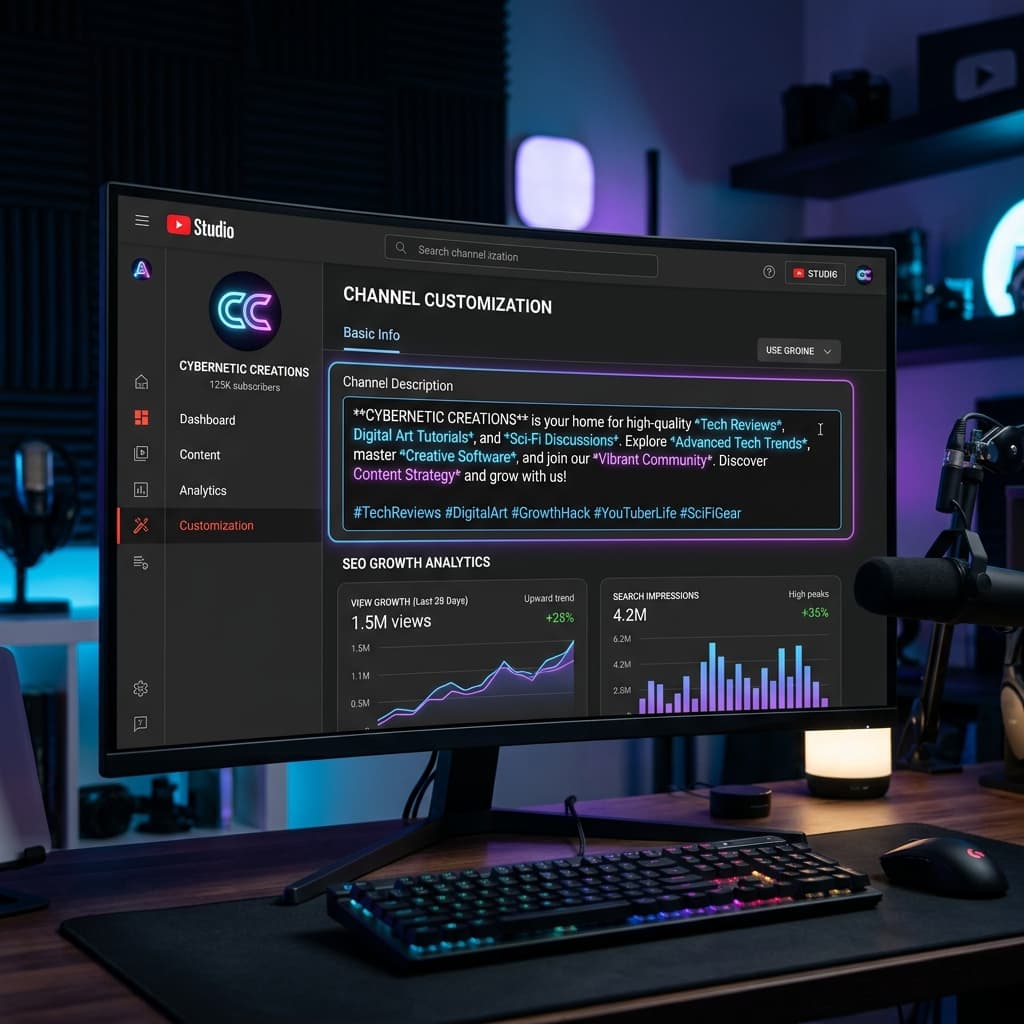
We automate the layout of your descriptions—ensuring your primary keywords are in the first 2 lines, followed by a value statement and structured chapters for Google Key Moments.

Cre8virals AI Description Generation

3. Tag Clusters & Disambiguation

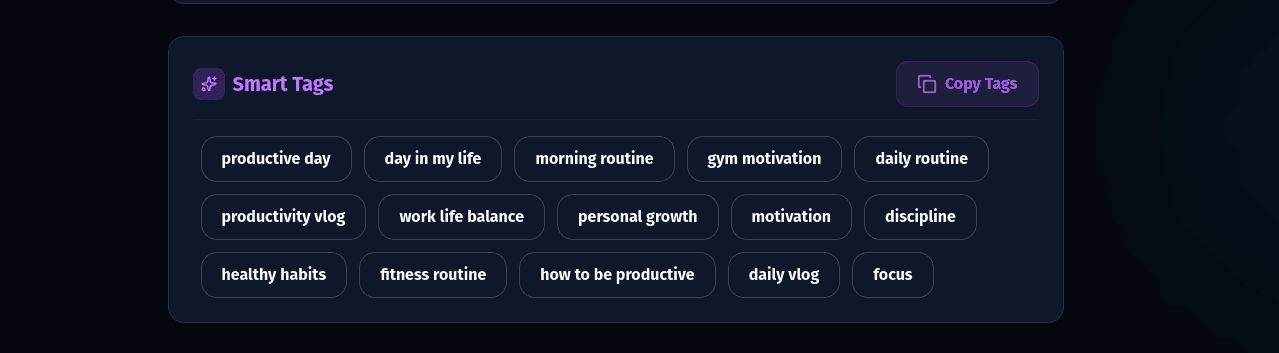
While tags are secondary, they are vital for disambiguation. Cre8virals generates weight-adjusted tag clusters that help YouTube understand the exact context of your video.

Cre8virals AI Tag Generation

Ready to automate your SEO?

Stop spending 5 hours on metadata. Use Cre8virals to generate algorithm-ready materials in 30 seconds.

The 300k Traffic Lifecycle

The Long Game of Evergreen Content

Passive traffic is the holy grail of YouTube. A video that ranks #1 for an evergreen search term will generate revenue and leads for years. Here is how you maintain that rank.

Freshness Updates

Every 6 months, update your title to include the current year. YouTube prioritizes 'fresh' content for technical or trending topics. A simple '(2026)' tag can revive a dead video.

Chapter Indexing

Add 'Searchable' names to your Chapters. Google Search extracts these to show 'Key Moments' in the SERP. This is how you rank on Google Web and YouTube simultaneously.

Passive Growth is Engineered.

If you follow the cluster strategy, every new video you upload strengthens the old ones. This is the 'Snowball Effect'. At 300k monthly views, your old content is doing 80% of the work.

Advanced: The 'Candidate Generation' Hack

Thinking like a YouTube Engineer

The YouTube recommendation engine (DeepMind-based) uses a two-stage process: Candidate Generation and Ranking.

1. Candidate Generation

The algorithm pulls a pool of thousands of videos that COULD match a user's interest. Keywords are what get you into this pool.

2. Ranking

The algorithm narrows those thousands down to the TOP 10 based on predicted satisfaction. Engagement (AVD/CTR) is what gets you to the top of this list.

Most gurus only talk about Stage 2. But if your keyword research is weak, you will never even make it into the candidate pool. You are invisible before the race even starts.

Conclusion: The 2026 Roadmap

Actionable Next Steps

You now have the exact blueprint to build a 300k+ organic traffic engine on YouTube. The tools are just the beginning; the strategy is what wins.

Your Homework:

  • 1

    Identify one 'Hub' topic for your niche.

  • 2

    Use the underscore method to find 5 long-tail 'Spoke' keywords.

  • 3

    Write a script that mentions your primary keyword in the first 15 seconds.

  • 4

    Design a thumbnail that complements (not repeats) the title.

Stop chasing the algorithm. Start serving the viewer.

Rankings follow value. Always.

Frequently Asked Questions

Q:Is high search volume the most important factor in 2026?

A:

No. In 2026, 'Search Intent Match' and 'Retention Potential' are far more important. A lower volume keyword with 80% average view duration will outrank a massive keyword with 20% retention every time.

Q:How long does it take for YouTube SEO to kick in?

A:

YouTube typically 'tests' your metadata changes within 4-12 hours. However, the true ranking maturity, where the algorithm settles your video in the recommendations, usually takes 14-21 days of data gathering.

Q:Should I focus on local keywords for my global channel?

A:

Yes. 'Geographic Staging' is a powerful 2026 tactic. Ranking #1 for a specific term in a secondary market (like the UK or Canada) can provide the initial velocity signals needed to push your video to the much larger US audience.

Automate your YouTube
Growth.

We've built a suite of AI tools specifically for the 2026 YouTube algorithm. From multimodal clustering to viral topic generation, we handle the technical SEO so you can focus on being creative.