Cre8Virals logoCre8Virals
Verified Strategy • 2026 Update

YouTube SEO Checklist 2026

15 min read
April 26, 2026
Ritesh Yadav
YouTube SEO Checklist 2026

Phase 0: The Semantic Revolution

Understanding the 2026 Algorithmic Shift

Before we dive into the checklist, we must address the "Elephant in the Server Room": Semantic Intent Indexing. In 2026, YouTube has moved away from simple keyword matching. The algorithm now uses "Candidate Generation" models that analyze the entire context of your video—not just the text you provide.

This means "tricking" the algorithm is dead. Instead, we must provide Multimodal Clarity. YouTube's AI now "watches" your video at a pixel level and "listens" to every word to verify if your metadata matches your content. Discrepancy is the fastest way to get suppressed.

The 2026 Hierarchy of signals:
  • 1.Audience Satisfaction (AVD + CTR): Still king, but now measured against specific "Intent Cohorts".
  • 2.Transcript Fidelity: How well your spoken words match your title and description.
  • 3.Visual Content Mapping: The AI identifies objects, text, and faces in your video to categorize it.

Phase 1: Deep Research

The Strategic Foundations of Virality

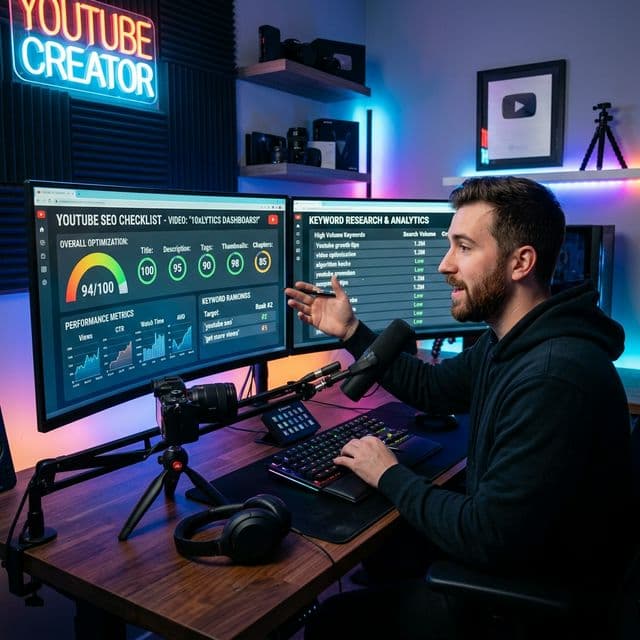
This is where most creators skip steps — and it's the one that determines 60% of your video's ceiling before you've recorded a single second. In 2026, YouTube SEO isn't just about what you type; it's about what you validate.

Keyword Validation

Check if top videos have 20K–80K views (manageable) or 500K+ (highly competitive). Data-driven mapping is the only way to find your breakthrough gap.

Search Intent Mapping

Does the keyword need a tutorial, a list, or an explainer? You must match the content type that already dominates the search results.

The Intent-Match Rule:

"YouTube rewards videos that satisfy the same intent as what already ranks. If all top results are 15-minute step-by-step tutorials and you post a 4-minute overview, you'll struggle to outrank them regardless of SEO. In 2026, this is called 'Intent Density'—the number of value-per-minute signals you provide relative to the average of the Top 5 results."

Competitor Gap Analysis

Don't just copy the winners. Look for what they missed. Use a tool to analyze the comment sections of the top-ranking videos for your keyword.

Are users asking questions that aren't answered in the video? That question is your "SEO Hook". Including that answer in your transcript and description signals to YouTube that your video is more comprehensive than the existing incumbents.

Phase 2: Metadata Optimization

Calculated Relevance for 2026

The difference between professional channels and amateurs is the time spent on the "First Impression" metadata. Front-loading is the 2026 industry standard.

Title Formula: Primary First

[Primary Keyword] — [Compelling Hook or Benefit] ([Year])

Front-load your primary keyword. YouTube's algorithm weights keywords that appear in the first 3-4 words more heavily for search-to-home-page indexing.

The "Parenthesis" Hack

Data shows that adding context in brackets or parentheses—e.g., (Step-by-Step), (Solved), or (2026)—increases CTR by up to 14%. It provides immediate proof of freshness and depth.

Secondary Keyword Stacking

Once you have your primary keyword at the start, use the rest of the 100-character limit for 2-3 secondary keywords that describe the sub-topics covered in the video.

The 3-Zone Description

Structuring for Human and AI Indexing

1. The Hook (First 2 Lines)

Keyword-rich snippet that appears in search results. Answer: Why watch this? This triggers the initial CTR signal.

2. The Value Statement

Expand on lessons, secondary keywords, and include Chapters for Google SERP real estate. This is where you clear the 'Information Debt'.

3. Links & CTAs

Relevant tools, related posts, and social links. Build your ecosystem around every upload.

The Visual Click Trigger

Mobile-First Thumbnail Logic

YouTube SEO isn't just text; it's visual. If your keyword strategy works but your thumbnail fails, your SEO score will plummet due to low engagement-to-impression ratios.

Contrast

High contrast between text and background is non-negotiable for mobile visibility in a crowded feed.

Word Count

Maximum 4 words of text. Each word must earn its place or it's just visual noise.

Blur Test

Shrink to 90x50px. If you can't understand it instantly, it's too complex for the fast-scrolling thumb.

Deployment & Velocity

Seeding the Algorithm

Successful indexing requires initial velocity. You must 'feed' the algorithm in the first windows of opportunity.

  • Audience Heatmap Timing: Schedule uploads during your peak windows. Early view velocity in the first 24 hours is a primary signal for algorithm broad-casting.
  • External Traffic Seeding: Embed videos on your blog or share on Reddit/Quora within 48 hours to increase algorithmic resilience.
  • The 48-Hour Comment Rule: Reply to every comment in the first two days to keep recency signals active.

The "Cross-Pollination" Strategy

In 2026, YouTube views traffic from other Google properties (Search, Discover) as high-quality signals. If you can get your video to rank in Google Search results, YouTube will give you a "Trust Boost".

The secret? Structured Data. Use clear chapters in your description. Google uses these to create "Key Moments" in Search results, which can drive thousands of "Free" views that fuel the YouTube algorithm's recommendations.

Phase 3: Retention-Based SEO

The Optimization of Time

In 2026, "Session Duration" is an SEO signal. If your video is the last one a user watches before closing the app, it's a negative signal. If your video leads to a "Rabbit Hole" (watching more of your content), your rankings will soar.

The End-Screen Bridge

SEO isn't just about discovery; it's about retention. Link to a video that answers the "Next Logical Question" your viewer will have. This signals to YouTube that your channel provides a complete journey.

Pattern Interrupts

High-ranking videos in 2026 use a visual or auditory change every 45-60 seconds. This maintains the "Dopamine Loop" required for high Average View Duration (AVD).

The AVD Thesis:

"Retention is the ultimate validation of SEO. If your metadata gets them through the door but your content fails to keep them, YouTube will de-rank you for the keyword, even if you're perfectly optimized."

Phase 4: Shorts-to-Long SEO

The Vertical Funnel

You cannot ignore Shorts in 2026. They are the "Top of Funnel" for your SEO strategy. But most creators use them wrong.

The 2026 Shorts Checklist:

  • Link the Short to your long-form video using the "Related Video" feature.
  • Use the same primary keyword in the first 3 words of the Shorts title.
  • Ensure the Short addresses a specific "Micro-Intent" within the larger topic.
  • Post the Short 24 hours after the long-form video for a second wave of views.

8 Fatal SEO Mistakes

The Critical Failure Points

!

Keyword in description, but missing from title.

!

Using only the exact-match keyword as a tag.

!

Zero chapters in videos exceeding 5 minutes.

!

Generic 'Welcome back' intro lines above the fold.

!

Ignoring the Audience Heatmap for upload timing.

!

Never revisiting or refreshing old metadata.

!

Ignoring a CTR drop for more than 7 days.

!

Relying 100% on internal YouTube traffic.

Advanced: Spoken SEO

Indexing the Voice Layer

In 2026, YouTube's search algorithm indexes your video's closed captions directly. This means the keywords you speak are indexed as primary relevance signals.

"Editing your auto-generated captions ensures the indexed text matches your keyword strategy exactly. If you say your primary keyword in the first 15 seconds, ensure it is transcribed correctly for the candidate generation engine."

Success on YouTube in 2026 isn't about running more complicated operations. It's about being more disciplined with your voice layer than your competitors.

The "Evergreen" Audit

SEO isn't a one-and-done task. Every 90 days, you should revisit your top 10 potential evergreen videos. Has the search intent changed? Are there new trending keywords you can swap into the first 2 lines of the description? Small metadata tweaks on a 6-month-old video can trigger a "Second Spike" in the 2026 recommendation engine.

Recommendation: Use A/B testing for thumbnails on underperforming evergreen content to revive its CTR and ranking maturity.

Final Strategic Summary

The 2026 Competitive Edge

YouTube SEO in 2026 is no longer about "hacking" the system—it's about feeding the system the high-quality data it needs to recommend your content to the right people.

By following this checklist, you are ensuring that every upload has the maximum possible surface area for Discovery. Remember: SEO gets you the impression, but Engagement keeps the ranking. Focus on the value, and the algorithm will follow.

"The best SEO is content that people actually want to finish."

Never sacrifice the viewer experience for a keyword match.

Frequently Asked Questions

Q:Should I use AI for entire descriptions?

A:

AI should handle the structure (3-zone framework, technical chapters), but you should always add 'Personal Context' in the hook to bypass AI-detection algorithms that some platforms use.

Q:Are YouTube 'Tags' still relevant for SEO in 2026?

A:

Only for 'Disambiguation'. Tags help YouTube distinguish between similar terms. They contribute less than 2% to your overall ranking compared to Titles and Transcript index signals.

Q:How long until I see results from SEO changes?

A:

YouTube indexes changes within 4-12 hours. However, 'Ranking Maturity' usually takes 7-14 days as the algorithm tests your satisfaction scores with different audience segments.

Automate your SEO
workflow.

We've built a suite of AI tools to handle this checklist for you — from front-loading keywords in titles to structuring 3-zone descriptions automatically.