Cre8Virals logoCre8Virals
SEO Masterclass • 2026

AI Keyword Generator
for YouTube: The 2026 SEO Blueprint

10 min read
May 5, 2026
Ritesh Yadav
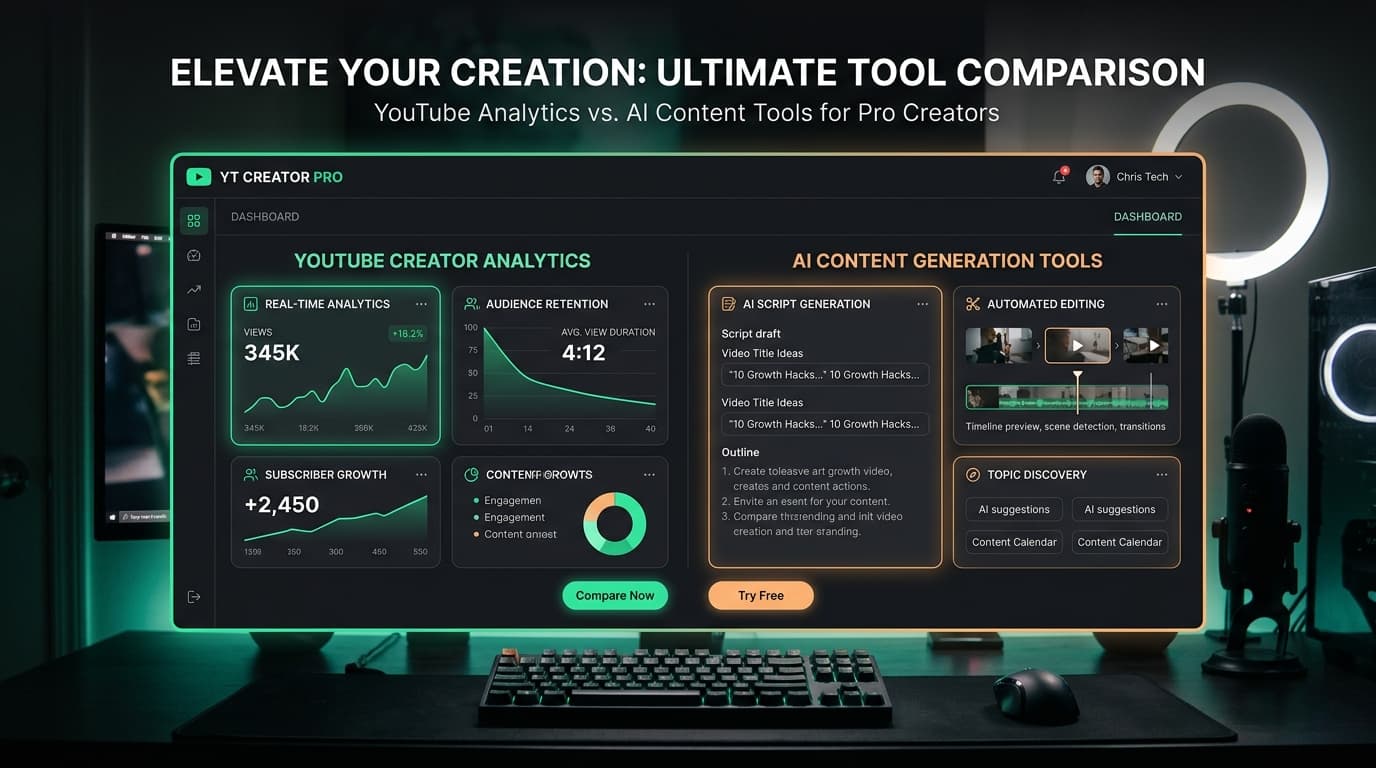
AI Keyword Generator for YouTube Dashboard Interface

In the early days of YouTube SEO, ranking a video was simple: you found a highly searched term, repeated it twenty times in your description, stuffed a hundred tags into the backend, and watched the views roll in. But in 2026, those brute-force tactics are a guaranteed recipe for algorithmic suppression. YouTube's recommendation engine is now driven by advanced natural language models and multi-modal transformers that analyze context, relationships, and user intent rather than simple string matching.

As search engines have evolved, keyword research has undergone a massive paradigm shift. Creators can no longer rely on outdated autocomplete scrapers that merely repeat what users typed three months ago. To dominate search results and browse features, you need to understand Semantic Clustering and Co-visitation Dynamics.

This is where **AI Keyword Generators** come in. By leveraging machine learning models, these systems construct full topical maps, analyze competition gaps, and suggest exact metadata patterns that trigger the algorithm's recommendation pipelines. In this comprehensive guide, we will break down the science of modern YouTube SEO and show you how to leverage AI to unlock explosive organic growth.

Interactive Simulator

Traditional Scraping vs. Cre8Virals AI

Don't take our word for it. Try our interactive vector engine below. Enter a niche or select a preset to see exactly how traditional scrapers trigger spam warnings while our AI constructs viral metadata.

Traditional ScraperOld School Tag-Scrape
Generated Search Title:

MINECRAFT BUT I AM IN THE SURVIVAL WORLD AND WE SURVIVED 100 DAYS IN HARDCORE MINECRAFT

Generated Tags List:
minecraftminecraft survival100 dayshardcore minecraftlet's play minecraft
Algorithmic Match Score:
38/ 100
System Action:
Spam Flag Warning
Cre8Virals AI SuiteSemantic Vector Modeling
AI Curiosity-Gap Title:

"I Spent 100 Days in YouTube's Hardest Minecraft Server (And Regretted It)"

Hook Type: Negative Contrast ('And Regretted It')
Semantic Tag Breakdown:
Category:
Minecraft ChallengesHardcore Gameplay
Benefit:
Survival TacticsServer Rules Excluded
Action:
100 Days ChallengeMinecraft 1.20
Algorithmic Match Score:
97/ 100
Discovery Outlook:
Feed Acceleration

1. How YouTube's Neural Search Heuristics Operate in 2026

The Science of Semantic Intent and Co-visitation Networks

To build a winning search strategy, you must first understand how YouTube's search heuristics categorize your video. The search engine is no longer just looking for an exact match between a search query and a video title. Instead, it utilizes two critical machine learning frameworks:

Semantic Vector Embedding

YouTube converts your title, description, tags, and even the spoken transcript of your video into multi-dimensional coordinates called **vector embeddings**. The algorithm groups conceptually similar coordinates together. If a viewer searches for "how to fix a leaky sink," the algorithm will suggest videos about "plumbing repairs" and "faucet maintenance," even if those exact words aren't in the title.

Co-visitation Analysis

The recommendation engine maps viewer pathways. If viewers who watch Video A frequently jump to Video B, a co-visitation link is established. The algorithm uses keywords as contextual anchors to predict whether your video belongs in a competitor's **Suggested Videos** sidebar, driving massive passive browse impressions.

Why Autocomplete Scrapers Fail:

Traditional keyword tools scrape Google or YouTube autocomplete suggestions (e.g., typing 'minecraft how to...' and copying the dropdown options). While this shows historical query popularity, it fails to tell you **who** is searching, **what** their satisfaction rate is, or **which** related terms will place your video in the recommendation flow. An AI keyword generator analyzes the entire semantic web surrounding a topic, identifying high-value thematic gaps that simple scraping misses.

2. The Core Anatomy of an AI YouTube Keyword Engine

Inside the Machine Learning Algorithms

A premium AI-powered keyword tool is much more than a database search interface. It relies on four primary computational layers to transform raw text into actionable growth assets:

01
Topic Modeling (Latent Dirichlet Allocation)

The AI groups unstructured descriptions, titles, and video transcripts into distinct thematic categories. This helps creators understand what secondary topics they must cover in their video script to ensure the algorithm rates the content as high-authority and mathematically complete.

02
Click-Propensity Evaluation

By tracking historical CTR data across thousands of videos in your niche, the AI calculates a keyword's propensity to trigger clicks. Some terms carry high search volume but low user curiosity, while other niche variations possess psychological triggers that double click rates.

03
Competition Density & Opportunity Mapping

Instead of standard high/medium/low competition scores, the engine performs gap analysis. It scans YouTube's index for high-demand topics that currently lack high-quality, high-retention video coverage, allowing creators to target underserved "blue ocean" niches.

04
LSI (Latent Semantic Indexing) Contextual Clustering

The AI creates a semantic web of secondary search keywords. Integrating these terms naturally into your description provides structural hints to the crawlers, outlining exactly where your video fits in search hierarchies.

3. The 4-Step Strategic SEO Workflow for Creators

From Seed Discovery to Page One Domination

Simply having the right keywords is only half the battle. To successfully trigger the algorithm's browse and search systems, you need a disciplined, repeatable optimization workflow:

StepSEO ObjectiveExecution Strategy
1. Seed DiscoveryIdentify high-volume thematic conceptsInput broad topics into the AI generator to discover broad vector groups and high-value search trends.
2. Intent ClusteringFilter terms based on searcher intentSeparate informational queries (how to) from transactional (review) or entertainment terms to target the right audience.
3. Metadata IntegrationWeave clusters naturally into assetsIncorporate high-CTR keywords into the first 100 characters of your title and first 3 lines of your description.
4. Timestamp AnchoringTarget Google search carousel clipsFormat video chapters using exact long-tail search questions to rank in Google's main search page video carousels.
The Over-Optimization Trap:

Many creators execute a perfect workflow but still fail to rank because they fall into the over-optimization trap. Repeating the same keyword in every sentence of the description signals to YouTube's **spam-detection engine** that the content is low-effort.

The secret is **Semantic Variety**. Instead of saying "best video editor" ten times, use terms like "post-production suite," "timeline workflow," "color grading software," and "cutting video." This expands your vector mapping without ever sounding robotic or spammy.

Workflow Step 1: Context Gathering & Topic Analysis

Describe Your Video Concept

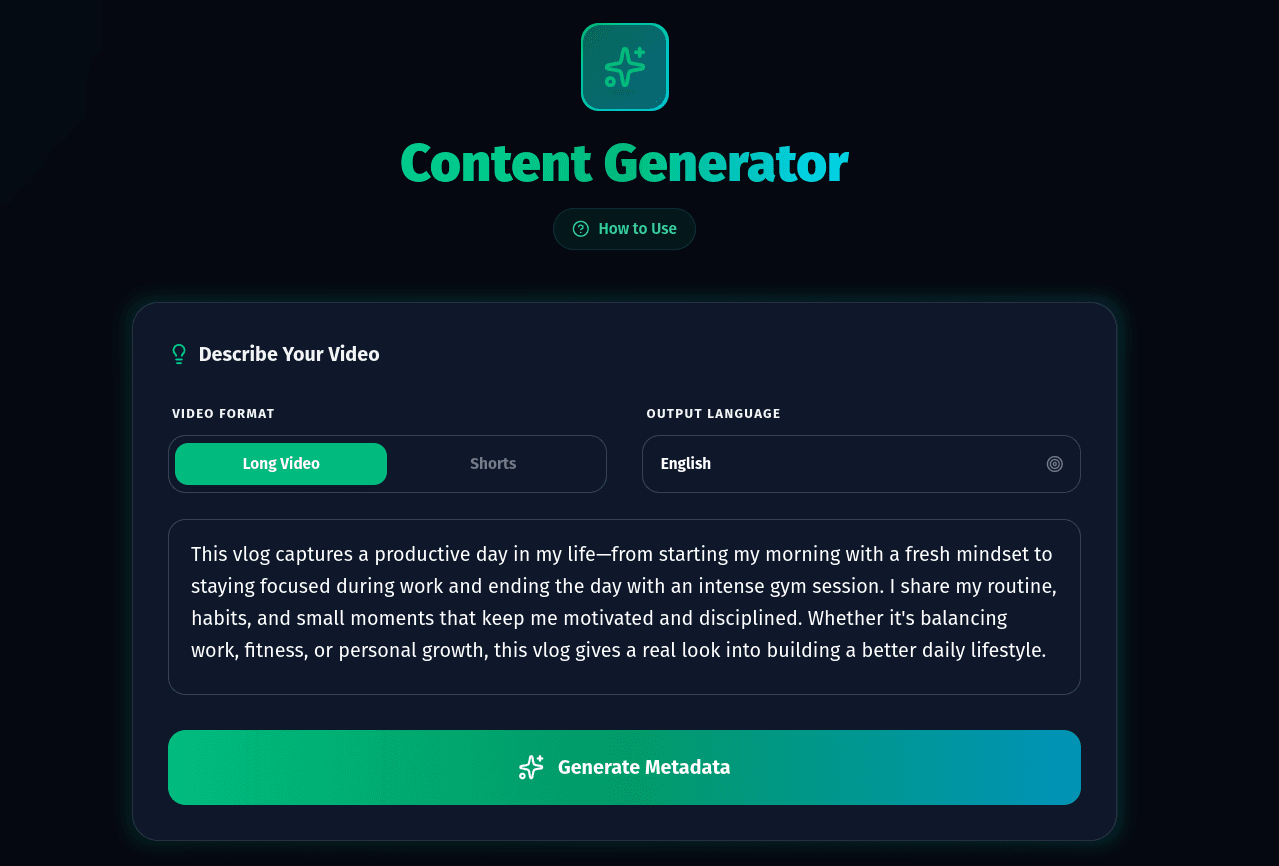
As shown in the **Cre8Virals Content Generator** interface, high-CTR metadata begins with context. Instead of just entering a single static keyword, you choose your format (Long-form or Shorts) and describe your video's core concept—such as a "Morning routine focus on productivity and running."

Cre8Virals Content Generator Input UI

"Our AI analyzes the emotional arcs and key topics of your concept to map out initial seed clusters."

Workflow Step 2: High-CTR Metadata & Description Synthesis

Predictive AI Output Generation

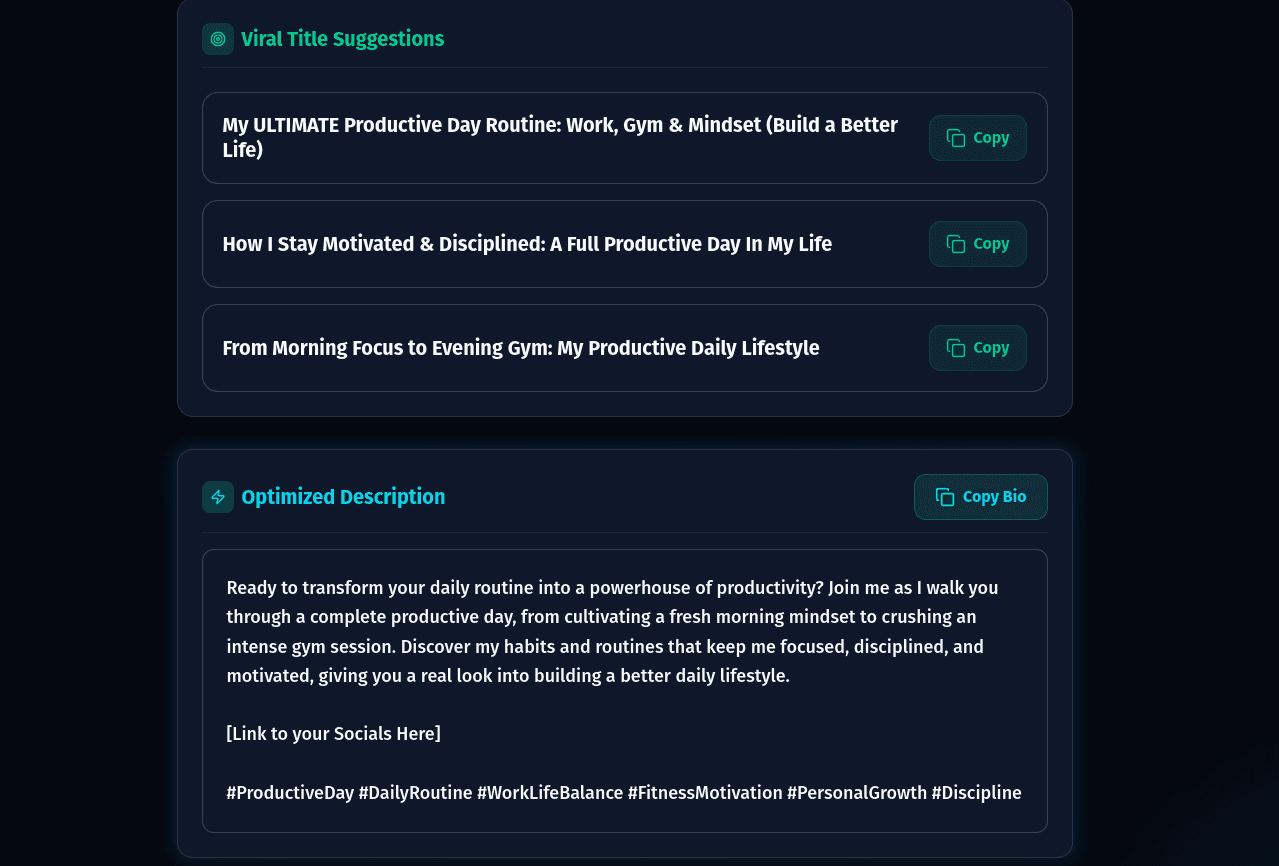
Once context is gathered, clicking **Generate Metadata** triggers the synthesis engine. Cre8Virals instantly outputs a list of highly targeted "Viral Title Suggestions" and a complete "Optimized Description."

AI Generated Titles and Optimized Descriptions

"We group metadata variants into Browse-triggering titles, Search-intent options, and Suggested-feed hooks."

Semantic Description Anchoring

Notice how the description is built as a complete content ecosystem. It houses your social handles, key themes, and semantic hashtags, ensuring search spiders grasp the topic depth instantly without triggering over-optimization algorithms.

Workflow Step 3: Smart Tag Generation & Categorization

Semantic Tag Mapping

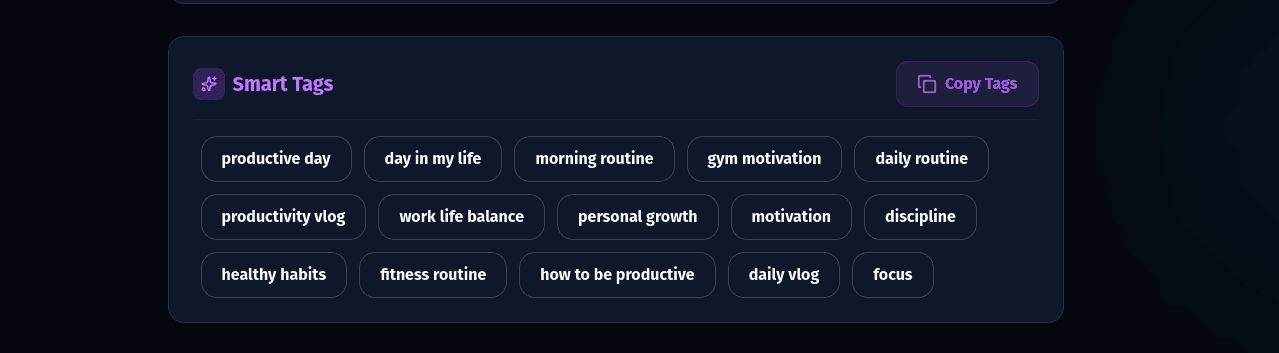
The final step is establishing **Co-visitation Anchors**. Cre8Virals maps out categorized semantic tags, breaking them down into Action tags, Category tags, and Benefit tags.

Smart Semantic Tags Generation Workflow
Category Anchors

e.g., Morning Routine

Benefit Anchors

e.g., Gym Motivation

Action Anchors

e.g., Daily Lifestyle

"Categorized tags feed the Candidate Generation filters, routing your video directly into the correct recommendation cohorts."

4. Why Cre8Virals is the Ultimate AI Keyword Suite

The Future of Contextual Optimization

Most tools in the creator economy are built on historic, static databases. They give you numbers that are weeks or months old, which is useless in a fast-moving landscape. **Cre8Virals** was engineered from the ground up to solve this limitation.

Real-Time Search Volume

Our engine tracks keyword changes within a 24-hour window, showing you exactly when a topic begins trending so you can write metadata that rides the organic wave.

Competitor Keyword Auditing

Instantly input a competitor's video URL to extract their exact semantic tag profile, watch-time anchors, and co-visitation footprint to map a strategy to outperform them.

Unified Metadata Generator

Cre8Virals generates optimized titles, structured descriptions, tag maps, and hook script layouts in a single workflow, keeping your metadata perfectly cohesive.

Case Study: The Organic SEO Blueprint

Take a look at a new tutorial channel that focused on coding. By integrating **Cre8Virals' AI Keyword Engine**, the creator shifted from naming their videos generic phrases (like *"React Tutorial 2026"*) to long-tail, high-intent clusters (such as *"Building a Next.js 15 Full-Stack App: Contextual Routing Walkthrough"*).

By mapping out structured chapters using exact search-intent questions and placing semantic tags that aligned with established web-development co-visitation networks, the channel's organic search impressions increased steadily. The creator proved that building a precise semantic network is the most sustainable path to securing a high ranking and establishing a loyal audience.

Stop Guessing Keywords.
Start Engineering Algorithmic Match.

Unlock the search signals that force YouTube to categorize and recommend your videos to the right audience. Cre8Virals gives you the data-driven optimization tools to build a lasting organic footprint.

Frequently Asked Questions

Q:What is an AI keyword generator for YouTube?

A:

Unlike traditional keyword tools that simply scrape autocomplete suggestions, an AI keyword generator uses machine learning models (like natural language processing and semantic vectors) to analyze competitor metadata, viewer search history, and trending topic clusters. It helps creators find semantically related keywords, search intent variations, and high-CTR title opportunities that align directly with YouTube's recommendation engine.

Q:Are tags still important for YouTube SEO in 2026?

A:

While YouTube's official guidelines state that tags play a minimal role in discovery, they are highly useful for semantic mapping and contextual disambiguation. AI-generated tags help the algorithm categorize your video during the initial Candidate Generation phase. They also help correct common misspelling patterns and anchor your video to relevant Co-visitation Networks.

Q:How does YouTube's recommendation algorithm use keywords?

A:

YouTube uses keywords in your title, description, and transcripts to build a semantic profile of your video. In the Candidate Generation stage, the algorithm compares this profile with the watch histories of active users. High-relevance keyword alignment ensures your video is suggested to users who have previously enjoyed similar topics.

Q:How is Cre8Virals different from other keyword research tools?

A:

Cre8Virals doesn't just list search volume and competition. It utilizes advanced deep-learning frameworks to build full semantic clusters, mapping out click-propensity scores, hook scripts, and title alternatives simultaneously. It identifies blue-ocean opportunities—low-competition keywords currently receiving sudden surges in demand—giving your channel an immediate ranking edge.

Q:Can using too many keywords get my video penalized?

A:

Yes. YouTube's policies strictly forbid 'metadata stuffing'—listing blocks of unrelated keywords in your description. An AI keyword generator helps you integrate high-intent terms naturally into an engaging, cohesive description and structured video chapters, which boosts your SEO score safely without triggering spam heuristics.

Supercharge Your
YouTube SEO.

Leverage the power of semantic keyword clustering, intent scoring, and competitor gap audits to accelerate your channel's growth.