

April 1, 2026•10 min read
I Analyzed 100+ Viral YouTube Videos — Here are the Patterns
Deep dive into 100+ outlier videos hitting 1M+ views. Mapping the structural DNA of virality beyond the curiosity gap.

Decoding the Neural Engine of Vertical Discovery
Have you been feeling like your Shorts have suddenly stopped getting views? You're certainly not alone here! Most creators have seen their Shorts behave very differently from other forms of content, and it's almost baffling! As we move deeper into 2026, the YouTube Shorts algorithm has transitioned from a simple recommendation engine into a highly sophisticated Neural Interest Graph.
So, why do some YouTube Shorts go viral while others barely see the light of day? To answer that, we have to look past the surface level "views" and "likes" that dominated the conversation in 2023 and 2024. In 2026, the algorithm operates on a system of deep behavioral modeling. It doesn't just care that a viewer watched your video; it cares how they felt while doing it.
YouTube's product lead for Shorts, Todd Sherman, has often alluded to the idea that the platform is moving toward a "total satisfaction" model. This means the algorithm is now optimized to reduce "Swiped Away" events and increase "Remix Velocity." If your content is being used as a source for other creators or being shared directly via the new in-player DM system, your reach will explode. Let's break down the mechanics behind this multi-billion view engine.
The Two-Phase Neural Strategy
Forget traditional metrics like impressions and click-through rates; in the world of Shorts, view velocity is king. Compared to the traditional route of using impressions to test your content, the YouTube Shorts algorithm is more straightforward. It operates in two distinct, recursive phases: Explore and Exploit.
Initially, your Short is exposed to a small, targeted, “seed audience.” This group is selected based on their history with similar micro-niches. This phase is crucial because if this test group doesn't engage, your views will flatline at the 2k-5k mark. This is where the 'Seed Audience Wall' lives.
If the seed audience hits a 'Satisfaction Score' above the 90th percentile, the algorithm shifts into Exploit mode. It stops testing and starts scaling, pushing your content to millions of Home Feeds and the Shorts Shelf. In 2026, this phase can trigger multiple times, often weeks after the initial upload.
Creators used to believe the first hour was everything. While the first hour is indeed the "Explore" window, 2026 data shows that the algorithm now performs "Staggered Re-testing." If a video failed on Monday but similar topics start trending on Wednesday, the algorithm will re-enter the Explore phase for that older video. This is the "Late-Viral Boom" that has revitalized older channels.
As of March 31st, 2025, YouTube fundamentally changed how views are logged on the Shorts platform. In the old model, a viewer had to watch for several seconds (the "Intentional Watch") for a view to count. In 2026, **any Short that starts playing or replays is counted as a view**, with no minimum watch time.
Every loop of a Short now adds another view, which means passive replays inflate view counts significantly. While this looks great in your publicly visible dashboard, the *internal* algorithm looks at a much more rigorous metric introduced to filter out the noise.
Counts every start, loop, and auto-play. Useful for social proof, but meaningless for revenue and ranking.
Counts ONLY when the viewer interacts meaningfully or watches beyond the 5-second mark. These are the views that drive YPP earnings.
Algorithm Guardrail v5.2 Active
Why Subscribers No Longer Drive Reach
A common complaint in 2026 is that subscribers don't seem to see current Shorts. This is by design. The Shorts algorithm has evolved to be **interest-driven**, not subscription-driven. While your long-form videos still go to your sub-feed, your Shorts are routed directly to users currently expressing "Micro-Niche Interest" in the feed.
If a user watches a Short about cooking, the algorithm will test your cooking Short on them, even if they've never heard of you.
A bad Short won't kill your next long-form video. The systems are now independent growth vectors.
Shorts now have a dedicated search filter. High-intent search views are 5x more valuable for ranking.
"In 2026, the algorithm acts like a highly-trained librarian. It doesn't care who wrote the book (Subscribers), it only cares if the person walking through the door wants to read that specific genre right now (Interest Routing)."
What would you learn after studying 35 billion Shorts views on YouTube? Well, after extensive research, Nate Black has identified the "Sweet Spot" for the 2026 algorithm. His findings have turned traditional short-form wisdom on its head.
Nate found that videos are either **13 seconds** or **60 seconds** long tend to perform best. This is because they align with the natural attention cycles of the swiping brain. The 13-second Short targets raw dopamine, while the 60-second Short targets depth and satisfaction.
Consistency isn't just about daily uploads. Nate observed that channels that have published at least **200 Shorts** see a hockey-stick growth curve. The algorithm needs a critical mass of data points (Shorts) to accurately profile your channel's ideal routing destination.
Pro Insight from Ritesh Yadav:
"The first three seconds are no longer just about the 'Hook'; they are about the 'Genre Confirmation'. If the viewer can't tell exactly what the video is about within 0.5 seconds, the 'Swiped Away' metric will spike. Use bold, clear text overlays immediately to help the algorithm route your video faster."
Beating the System in 2026
Would you believe it, thumbnails still matter! In 2026, Shorts appear on the desktop Home feed as large cards. A compelling thumbnail is your secret weapon here. The algorithm tracks **Click-Through Intent** on desktop to determine if the Short should be pushed harder to the mobile feed.
Repurposing long-form is the #1 strategy for high volume. Using tools like **vidIQ's AI Clip Maker** or **Cre8Virals Pulse**, you can scan long videos for "Engageable Moments." The algorithm in 2026 is smart enough to detect recycled content; however, it *prefers* high-quality AI clips over lazy, unedited screen-records.
"Creators using automated AI clipping are seeing a 400% increase in production volume with zero loss in view-velocity. The machine is feeding the machine."
As of late 2025, YouTube introduced a dedicated **Audio Discovery Feed**. When users interact with a specific song, the algorithm presents a scrollable list of the most "Satisfying" Shorts using that track.
Don't pick a song from the 'Top 50'. Pick a song that is in its **rising phase** (less than 5,000 uses but over 1,000 uses in the last 24 hours).
Use a consistent intro audio snippet. The algorithm tracks **Sound-Source-Retention**, and will push your videos to people who have stayed for that specific audio intro in the past.
If you want hit 10 million views in 90 days, you need to optimize for **Satisfaction Signals**, not just watch time. Follow this hierarchy:
A share is worth 10 likes. A remix is worth 100 shares. Design your video to be REUSABLE.
Ensure the last frame and first frame are identical. Forced replays are now a tier-1 ranking signal.
Use keywords in the first 2 seconds of audio. The algorithm's speech-to-text is 99% accurate in 2026.
Use the persistent link feature to drive traffic to long-form. This stabilizes your channel's Trust Score.
Post when your specific micro-niche is active. Use the 'Audience' tab to find the heat-map peak.
High-bitrate exports (4K vertical) are now prioritized for Premium subscribers in the feed.
Getting more YouTube views is always a hot topic, and that's why so many of you want to understand the Shorts algorithm! But some of you may be thinking, *What do these views mean in the long run?* Sure, the big numbers look good, but how do you translate that into more valuable, monetizable views?
"The YouTube Shorts algorithm is not broken when it comes to attracting more long-form views. It is a funnel, not a standalone platform. Treat every Short as a 60-second ad for your brand, and the algorithm will reward you with the only thing that matters: Loyal, return-viewers."
A new update on YouTube has addressed the bridging issue. The 'Persistent Link' feature allows you to guide a viewer from a high-energy Short directly into a deep-dive long-form video. This is the ultimate growth hack for 2026.
At **Cre8Virals**, we focus every single tool on helping you navigate these complex algorithm shifts. Whether it's our AI Clip Maker or our Trend-Mapping engine, we're here to make sure your content doesn't just 'Exist'—it 'Dominates'.
An Engaged View is a metric introduced in March 2025 that counts views where a user interacts meaningfully (watching beyond the first 5 seconds, liking, commenting, or sharing). Unlike raw views, which count every loop and start, Engaged Views are what count toward YPP eligibility.
As of 2026, the algorithms are largely decoupled. While some 'Bridge Discovery' exists, a Short's success is primary determined by the 'Shorts Feed' behavior rather than your existing subscriber base.
This is the classic 'Seed Audience' wall. Your video passed the initial 'Explore' phase but didn't hit the retention or satisfaction thresholds (usually >85% APV) required for the algorithm to 'Exploit' it to a broader audience.
Yes, but primarily for categorization. The algorithm uses hashtags like #shorts and niche-specific ones to route your content to the correct micro-niche 'Search Shelf' and dedicated Shorts filter.
Don't guess the algorithm. Master it. Use Cre8Virals to decode trending micro-niches and scale your vertical reach to 10M+ views.
Deep dive into 100+ outlier videos hitting 1M+ views. Mapping the structural DNA of virality beyond the curiosity gap.
Learn how to setup a YouTube channel from scratch in 2026. Discover why you don't need a high-end camera, how top creators started, and how to scale to professional tools.
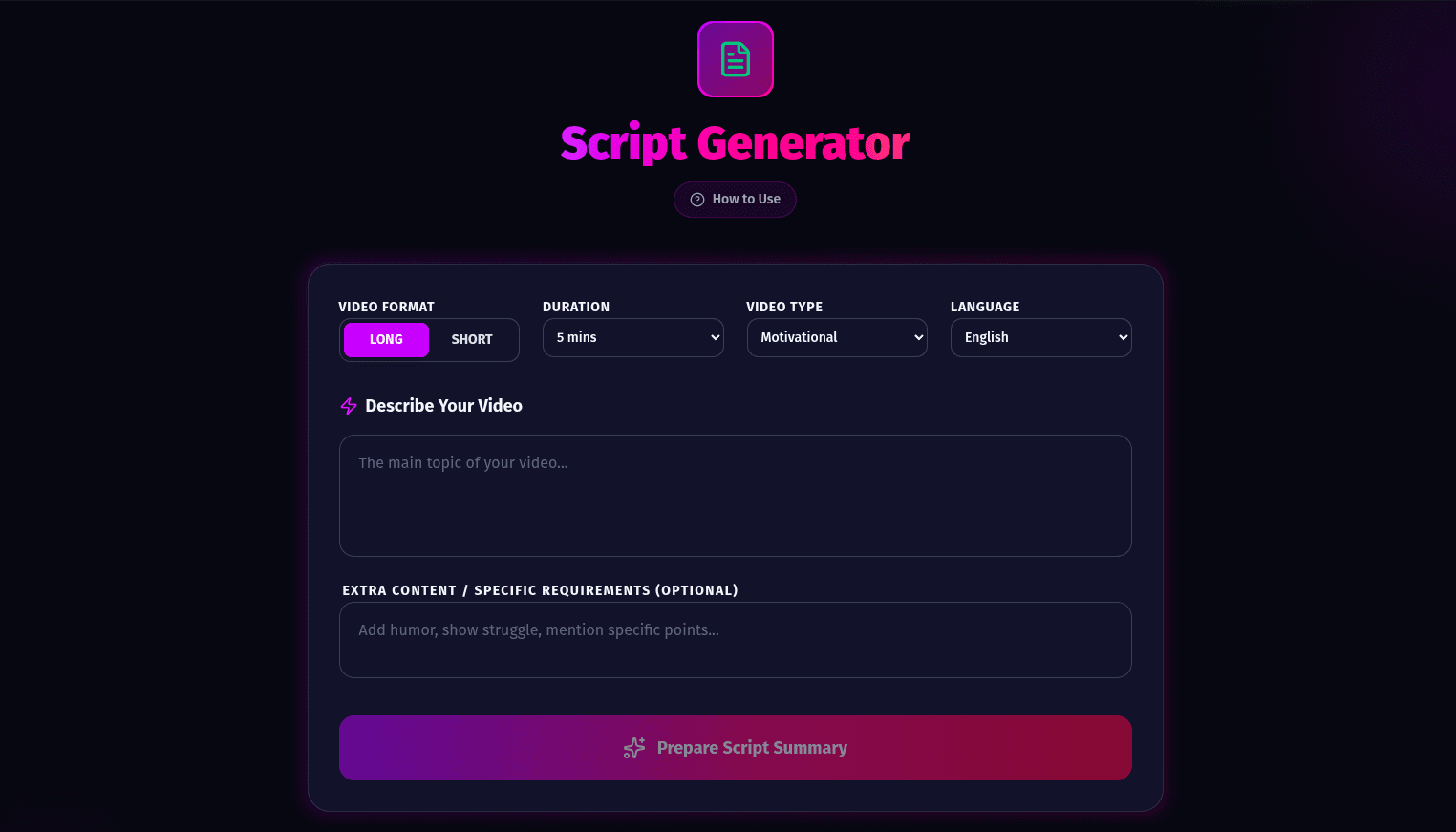
Write high-retention YouTube scripts using AI. Learn the rules of narrative hooks, pacing dynamics, retention bridges, and how Cre8Virals automates viral storytelling.